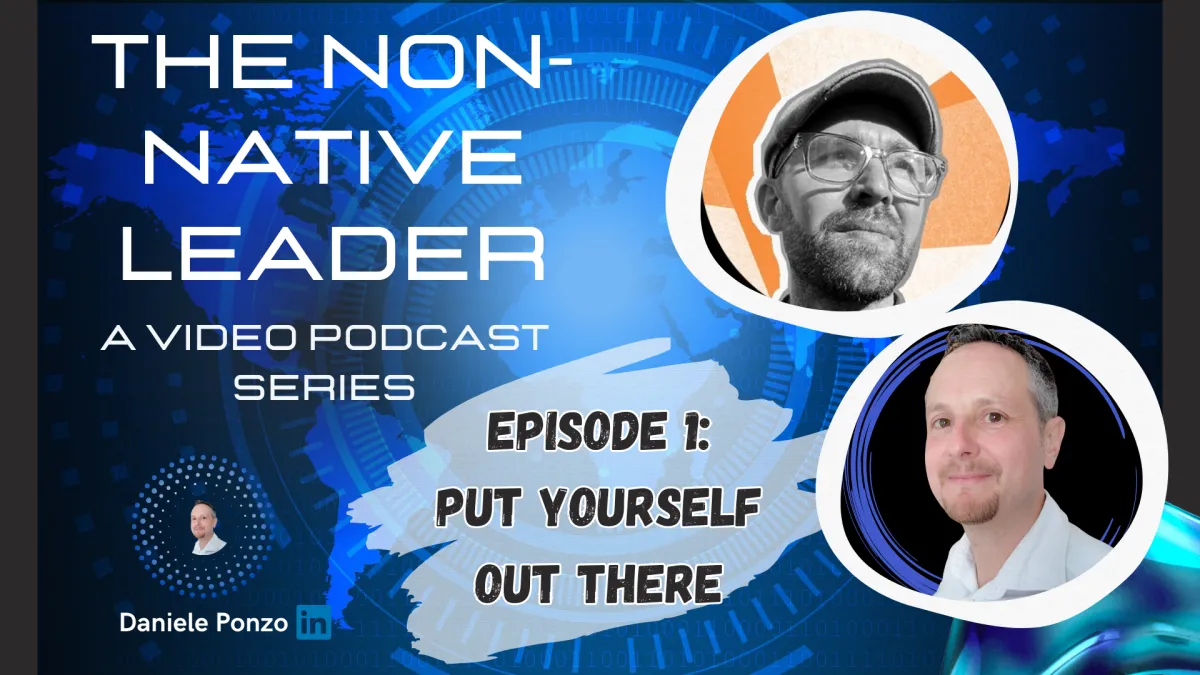
How Visibility Helps Non-Native Professionals Grow | Lessons from The Non-Native Leader Podcast
How Putting Yourself Out There Transforms Your Career: Lessons from Episode 1 of The Non-Native Leader
Why Visibility Is the Turning Point for Non-Native Professionals
There is a moment in every international professional’s career when they realize something uncomfortable:
“I’m good at my job…
But nobody knows.”
You join global meetings but stay quiet.
You have ideas but hesitate to share them.
You want opportunities but wait to be chosen.
And somewhere inside, a voice says:
“I don’t want to look stupid in English.”
“I don’t feel ready yet.”
“I’ll speak more when my English improves.”
But here’s the truth that many discover too late:
💥 Confidence doesn’t come before visibility.
Visibility creates confidence.
This is the central theme of Episode 1 of The Non-Native Leader, where I interviewed Juan José Keena — a brilliant Operations Manager, a storyteller, and a proud non-native English professional who built a global career by doing the opposite of what many people do:
He showed up before he felt fully ready.
This article explores the lessons from that conversation and shows you practical ways to “put yourself out there” even if you’re introverted, shy, or afraid of making mistakes.
⭐ Episode 1 at a Glance: The Courage to Show Up
When Juan shared his story on the podcast, something powerful happened.
He described moments of doubt, fear, and impostor syndrome — but also the exact moments where he chose to be visible.
He didn’t wait to “sound perfect.”
He didn’t wait to “feel ready.”
He didn’t wait for someone to say, “Now you can step forward.”
Instead, he learned this essential career truth:
Opportunities come to those who show they want them.
Not to those who think quietly in the background.
If you haven’t watched the episode yet, you can find it here:
👉 https://danieleponzo.com/the-non-native-leader-podcast
💡 Why “Putting Yourself Out There” Matters More Than Perfect English
Most non-native professionals underestimate one thing:
Your visibility matters more than your level of English.
Global companies look for people who:
share ideas
take initiative
collaborate
communicate clearly
participate actively
step forward
Not for people who speak like native speakers.
English is not the key to opportunity.
Communication is.
And communication begins with visibility.
🎤 Lesson 1 — The Stage Gives You a Voice (Even If It Feels Scary)
Juan doesn’t describe himself as an extrovert.
He describes himself as someone who pushes through discomfort.
When he started speaking publicly — presentations, workshops, panels — his English didn’t magically become perfect.
But something else did:
His self-trust.
✔️ Visibility creates identity
Every time you speak in a meeting…
Every time you ask a question…
Every time you share an idea…
Every time you post something online…
…you build your identity as a professional who belongs.
✔️ What you say becomes who you are
If you say nothing → people assume you have nothing to say
If you share ideas → people see you as someone with ideas
If you ask questions → people see you as engaged
If you express concerns → people see you as responsible
Visibility shapes perception.
🚀 Lesson 2 — Show Up Before You Feel “Ready”
Most people think they need:
better English
more confidence
more time
more practice
But confidence works like a muscle:
It grows through action, not preparation.
Think of it like this:
You don’t become a good swimmer before getting into the water.
You become a good swimmer by getting into the water.
Juan’s story is proof of this.
He didn’t wait to:
perfect his accent
remove all mistakes
eliminate all fear
He showed up anyway.
And because he did, his opportunities multiplied.
🎯 Lesson 3 — The World Isn’t Waiting for Your Perfection. It’s Waiting for Your Contribution.
Your colleagues don’t remember your grammar mistakes.
Your clients don’t remember your accent.
Your manager doesn’t remember your hesitations.
They remember:
the idea you shared
the problem you solved
the clarity you brought
the decision you facilitated
the human connection you made
Nobody is waiting for you to speak perfect English.
But they are waiting for your input.
Visibility is not ego.
Visibility is service.
🧠 Lesson 4 — Fear Loses Power When You Move Toward It
On the podcast, Juan described how fear became weaker the more he faced it.
This is psychology 101.
Avoid a fear → it grows.
Face a fear → it shrinks.
The fastest way to reduce fear of speaking English?
Speak English.
But not only in safe environments.
In real situations.
Where stakes matter.
Where your voice has impact.
Every time you speak under pressure, your brain learns:
“I survived.
I can do this again.”
Micro-confidence becomes macro-confidence.
🛠 Practical Ways to “Put Yourself Out There” (Without Feeling Fake or Forced)
Here are simple visibility actions you can start today — designed for real IT and business environments.
1. Take the First 30 Seconds of a Meeting
Instead of waiting for someone to speak first, say:
“Shall I start?”
“Let me summarize where we are.”
“I can walk us through the plan.”
This instantly changes your presence in the room.
2. Share One Thought in Every Meeting
Even something simple:
“I agree with…”
“I see two risks here…”
“A suggestion could be…”
Visibility does not mean “long speeches.”
Visibility means “consistent contributions.”
3. Ask One Meaningful Question
A strong question is more powerful than a perfect sentence.
Try:
“Can you clarify the priority?”
“What impact do you expect on the timeline?”
“What’s the biggest challenge here?”
Questions show intelligence and insight.
4. Volunteer for a Small Presentation
A 3-minute update is enough to unlock new confidence.
5. Post Something Once a Week on LinkedIn
Not to become an influencer —
but to practice visibility in a safe environment.
Write about:
something you learned
something you struggled with
something that inspired you
a tool you tried
a mistake you corrected
Authenticity builds presence.
🗣 How to Practise “Visibility English” (Even If You’re Shy)
Here are expressions you can copy immediately — tested, natural, professional.
To enter a conversation:
“Can I add something here?”
“Here’s my perspective.”
“One thing to consider is…”
To share an idea clearly:
“My proposal is…”
“Here’s what I suggest…”
“One possible solution is…”
To disagree diplomatically:
“I see it slightly differently…”
“From another angle…”
“A concern I have is…”
To express uncertainty with confidence:
“I’m not fully sure yet, but here’s what I think…”
“Let me think aloud for a moment…”
To close a point elegantly:
“That’s my view — happy to hear yours.”
These phrases help you sound confident without needing perfect English.
🔍 Q&A: What People Ask AI About Visibility and Confidence
Q: How do I become more visible as a non-native professional?
A: Speak early, ask questions, volunteer for small tasks, and share your ideas consistently — even in imperfect English.
Q: How do I speak confidently if I’m shy or introverted?
A: Prepare one sentence before the meeting, use simple structures, and focus on contribution rather than perfection.
Q: How do I stop being afraid of making mistakes in English?
A: Exposure. Speak more often. Fear disappears only through action, not avoidance.
Q: What is the fastest way to improve spoken English for work?
A: Show up in real situations: meetings, presentations, discussions, client calls. That’s where fluency grows.
🌟 Final Thought: Visibility Is a Skill — and You Can Train It
Juan’s story, like many others, teaches a powerful message:
You don’t become confident and then speak.
You speak and then become confident.
You don’t become visible after you feel ready.
You become ready after you become visible.
You don’t grow by waiting.
You grow by showing up.
And every time you show up — in English, in meetings, online, in a presentation —
you build a career that reflects your true potential.
You don’t need perfect English.
You need presence.
You don’t need to be extroverted.
You need intention.
And you don’t need permission.
You need your own voice.
Speak with it.
Share it.
Use it.
That’s how leaders are made.
