The Lean English Improvement Roadmap for IT Professionals (Using the DMAIC Method)
The Lean English Improvement Roadmap for IT Professionals (Using the DMAIC Method)
What If Improving Your English Worked Like Improving a Process?
If you work in IT, engineering, or operations, you already know something about process improvement.
You’ve probably heard terms like:
Lean
Six Sigma
continuous improvement
optimisation
reducing waste
But here’s an interesting question:
What if you approached your English improvement the same way?
Instead of treating language learning like school again — endless grammar exercises and random vocabulary — you could treat it like a process optimisation project.
That’s where the DMAIC framework comes in.
DMAIC is a well-known Lean Six Sigma methodology used to improve systems and processes.
And surprisingly, it works extremely well for improving professional English.
Why Traditional Language Learning Often Fails Professionals
Many IT professionals try to improve English by:
studying grammar rules
memorising vocabulary lists
watching random videos
reading generic textbooks
The problem?
These methods rarely address real communication needs.
Most professionals don’t need to:
describe their hobbies
order food at restaurants
talk about holidays
They need to:
run meetings
present ideas
negotiate solutions
explain technical problems
collaborate with international teams
That requires targeted practice, not general language study.
And this is exactly where process thinking helps.
The DMAIC Framework for Improving Your English
DMAIC stands for:
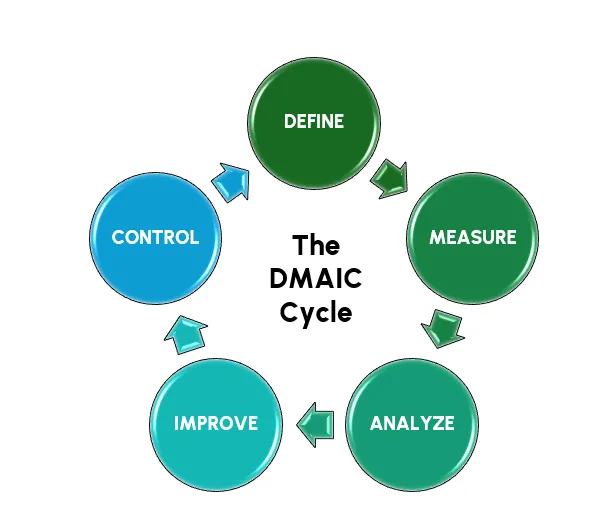
Define → Measure → Analyze → Improve → Control
Let’s apply this structure to language improvement.
1. Define Your Communication Goals
In Lean Six Sigma, improvement starts with defining the problem.
The same applies to English.
Instead of saying:
❌ “I want to improve my English.”
Define something specific:
✔ “I want to lead meetings confidently.”
✔ “I want to explain technical solutions to clients.”
✔ “I want to deliver presentations clearly.”
Example
A cloud architect might define their goal as:
“I want to confidently explain architecture decisions to international clients.”
This clarity makes improvement measurable.
Why Most People Skip This Step
Without clear goals, language learning becomes:
unfocused
frustrating
slow
You end up studying things you never use.
Define your real communication scenarios first.
If you’re unsure where to start, we can analyze your real communication needs together.
You can book a meeting with me and we’ll map out the most effective improvement strategy for your professional context.
2. Measure Your Current English Performance
The second DMAIC step is measurement.
You cannot improve what you don’t measure.
Ask yourself questions like:
Do I hesitate in meetings?
Do I struggle with presentations?
Are my emails too long or unclear?
Do I avoid speaking during calls?
Measurement creates awareness.
Example self-assessment
Strengths:
strong technical vocabulary
good reading comprehension
Areas for improvement:
speaking spontaneously
structuring ideas clearly
This step reveals where to focus your effort.
3. Analyze Your Learning Methods
The third stage is analysis.
Lean thinking asks:
What activities actually produce results?
Many professionals spend time on activities that look productive but aren’t.
Examples:
❌ Passive listening without speaking
❌ Reading without practising communication
❌ Memorising vocabulary without using it
Instead, identify methods that directly support your goals.
Effective learning methods
short daily speaking practice
presentation rehearsal
role-playing meetings
recording yourself speaking
These simulate real communication.
4. Improve Through Targeted Practice
Now comes the improvement stage.
Once you know your goals and weaknesses, you can design focused practice.
For example:
If meetings are difficult
Practice phrases like:
“From my perspective…”
“I’d like to add something here.”
“Let’s clarify the main point.”
If presentations are difficult
Practice structures like:
context → problem → solution
key points → implications → next steps
If emails are difficult
Focus on:
concise language
clear structure
strong verbs
Improvement happens when practice is contextual.
5. Control Your Progress
The final DMAIC stage is control.
This means tracking progress over time.
Many professionals abandon language learning because they don’t see improvement.
But improvement becomes visible when you measure it.
Simple tracking methods
record yourself speaking every month
review past presentations
track meeting participation
measure how often you speak up
These indicators show real progress.
Why Measurement Increases Motivation
When improvement is visible, motivation increases.
Instead of feeling stuck, you see:
clearer communication
faster responses
reduced hesitation
stronger confidence
This creates a positive feedback loop.
Real Example: Applying DMAIC to English
Imagine an IT manager applying the DMAIC process.
Define
Goal: lead international meetings confidently.
Measure
Problem: hesitates and speaks rarely.
Analyze
Current learning: passive listening.
Improve
Practice meeting phrases daily.
Control
Record meetings and track participation.
After several weeks, participation increases and confidence improves.
That’s process improvement applied to communication.
The Lean Principle: Reduce Waste in Language Learning
Lean thinking focuses on eliminating waste.
Common language learning waste includes:
studying irrelevant vocabulary
overthinking grammar
waiting to feel “ready”
passive learning without speaking
Instead, focus on activities that directly impact communication.
Questions About Improving English
What’s the fastest way to improve professional English?
Focus on communication scenarios you use at work instead of general language learning.
Can Lean Six Sigma help with language learning?
Yes. The DMAIC framework helps structure improvement and measure progress.
How much practice is needed to improve English?
Consistent daily practice — even 10–15 minutes — can produce strong results over time.
Final Thought: Treat English Like a Process, Not a Subject
Language learning doesn’t have to be chaotic.
When you treat it like a process:
goals become clear
progress becomes measurable
improvement becomes systematic
And this approach fits perfectly with the mindset many IT professionals already have.
Ready to Build Your English Improvement Roadmap?
If you’d like to design a structured approach to improving your professional English — tailored to your role, communication scenarios, and career goals — you can book a meeting with me and we’ll explore how to build your personal improvement roadmap.
