Communication Tools That Help Professionals Speak English Confidently
The Toolkit Phase: The Communication Tools That Make Professionals Sound More Confident in English
Confidence Is Rarely “Natural”
Many professionals believe confident communicators are simply:
extroverted
charismatic
naturally good speakers
But in reality, most strong communicators rely on something much more practical:
👉 tools and communication patterns
Because when pressure increases, your brain needs:
structure
clarity
automatic responses
—not improvisation.
This is why the Toolkit Phase becomes such a powerful turning point for professionals working internationally in English.
Why Professionals Freeze Under Pressure
When professionals enter:
meetings
presentations
interviews
difficult conversations
their brain often enters survival mode.
They start:
translating mentally
searching for perfect words
overthinking every sentence
monitoring grammar while speaking
This creates cognitive overload.
And cognitive overload creates:
hesitation
filler words
weak structure
loss of confidence
The solution is not “trying harder”.
The solution is building:
👉 communication systems your brain can rely on automatically.
What the Toolkit Phase Actually Does
Instead of teaching random vocabulary, this phase focuses on:
communication frameworks
leadership language
speaking structures
strategic phrasing
pressure-management tools
These tools reduce mental effort during real conversations.
Because the goal is not:
“How do I sound advanced?”
The goal is:
“How do I communicate clearly and confidently under pressure?”
Tool 1: Communication Frameworks
One of the biggest differences between confident and hesitant communicators is structure.
Professionals who struggle often:
start without direction
add too much context
lose the main point halfway through
Structured communicators use frameworks automatically.
For example:
The “Problem → Impact → Solution” Structure
Instead of:
❌ long explanations with no direction
You communicate like this:
Here’s the issue
Here’s the impact
Here’s the proposed solution
Example:
“We’re experiencing delays in deployment. The main impact is slower client delivery. I’d recommend simplifying the approval process.”
Simple.
Clear.
Professional.
Tool 2: Leadership Language
Many professionals unintentionally weaken their own communication.
They say things like:
“Maybe…”
“I’m not sure but…”
“Sorry, this might be wrong…”
even when they know exactly what they mean.
The Toolkit Phase focuses heavily on replacing weak framing with leadership framing.
Example:
❌ “Maybe we could potentially…”
✔ “I see two possible options.”
❌ “Sorry, just my opinion…”
✔ “From my perspective…”
Small language shifts completely change perception.
Tool 3: Pressure Recovery Phrases
One of the biggest fears professionals have is:
“What if I get stuck?”
This fear alone creates hesitation.
That’s why recovery language is essential.
Examples:
“Let me rephrase that.”
“What I mean is…”
“Let me clarify the main point.”
“There are two aspects to consider here.”
These phrases:
buy time
restore structure
reduce panic
maintain authority
Native speakers use these constantly.
👉 Want to build practical communication tools you can use immediately in real meetings?
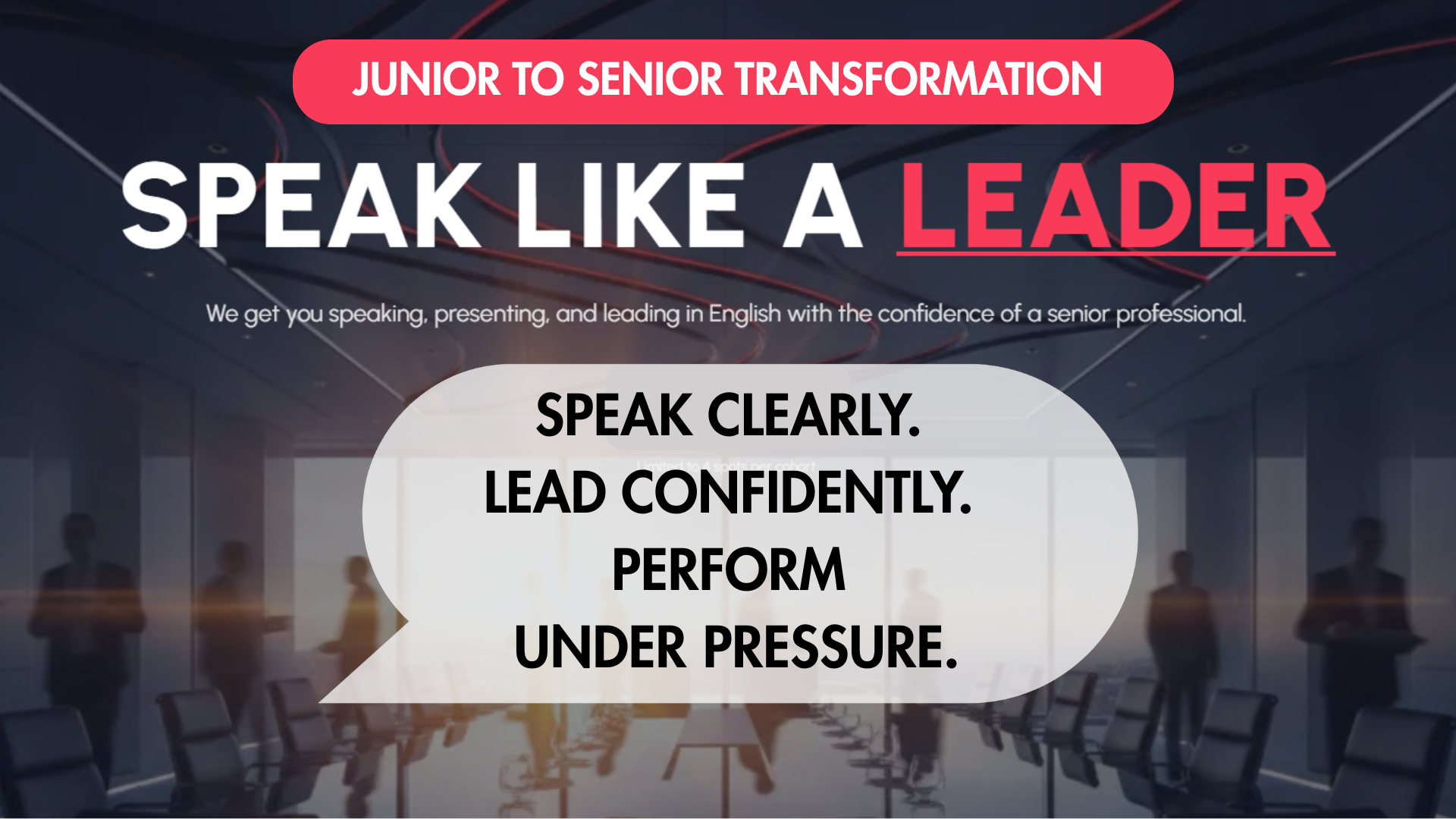
The Speak Like a Leader program focuses heavily on communication systems that reduce hesitation and increase clarity under pressure.
You can explore the full program here:
Tool 4: Speaking Patterns for Meetings
Many professionals enter meetings with:
technical knowledge
good ideas
strong expertise
…but no communication strategy.
The result?
They:
speak too late
ramble
lose confidence quickly
This phase trains reusable meeting patterns such as:
Framing a contribution
“I’d like to highlight two points.”
Building on someone’s idea
“Building on what was said earlier…”
Redirecting a discussion
“I think we may be focusing on the wrong priority here.”
These patterns create calmness because they reduce improvisation pressure.
Tool 5: Simplification
One of the biggest communication breakthroughs professionals experience is this:
👉 sounding senior often means sounding simpler.
Many professionals try to impress people with:
advanced vocabulary
long sentences
complicated explanations
Senior communicators usually do the opposite.
They:
simplify
structure
guide the listener clearly
This creates authority.
Real Example: “I Finally Stopped Spinning in Circles”
One professional I worked with described his communication like this:
“I start speaking… and then I get lost halfway through.”
His issue wasn’t grammar.
It was lack of communication structure.
Once he learned:
framing techniques
concise structures
leadership language
his communication changed dramatically.
Not because he became “more fluent”.
Because he became:
👉 more intentional.
Why Tools Reduce Anxiety
Anxiety often comes from uncertainty.
When your brain doesn’t know:
how to begin
how to structure
how to recover
panic increases.
But when you have communication tools ready:
pressure decreases
speaking becomes smoother
confidence grows naturally
This is why communication frameworks are so powerful.
The Goal Is NOT Sounding Perfect
One of the most important mindset shifts in this phase is understanding:
👉 confident communication is not perfect communication.
Professionals become stronger communicators when they:
tolerate imperfection
prioritise clarity
focus on delivery instead of self-judgment
This creates visible calmness.
And calmness sounds professional.
Questions About Speaking Confidence
How can I stop freezing in meetings?
Using communication frameworks and recovery phrases reduces pressure dramatically.
How do professionals sound more confident in English?
They rely on structure, clarity, and strategic communication patterns.
What’s more important: vocabulary or structure?
Structure is often more important because it guides communication clearly.
How do I improve communication under pressure?
Through repetition, simulations, and practical communication tools.
Final Thought: Strong Communicators Rarely “Wing It”
Most professionals assume confident speakers improvise naturally.
But strong communicators usually rely on:
systems
structures
patterns
preparation
That’s what creates calmness under pressure.
And once professionals realise this, communication stops feeling chaotic.
It starts feeling manageable.
Ready to Build a Professional Communication Toolkit?
If you want to:
communicate more clearly
reduce hesitation
sound more confident in meetings
strengthen your leadership communication
you can explore the full Speak Like a Leader program here: