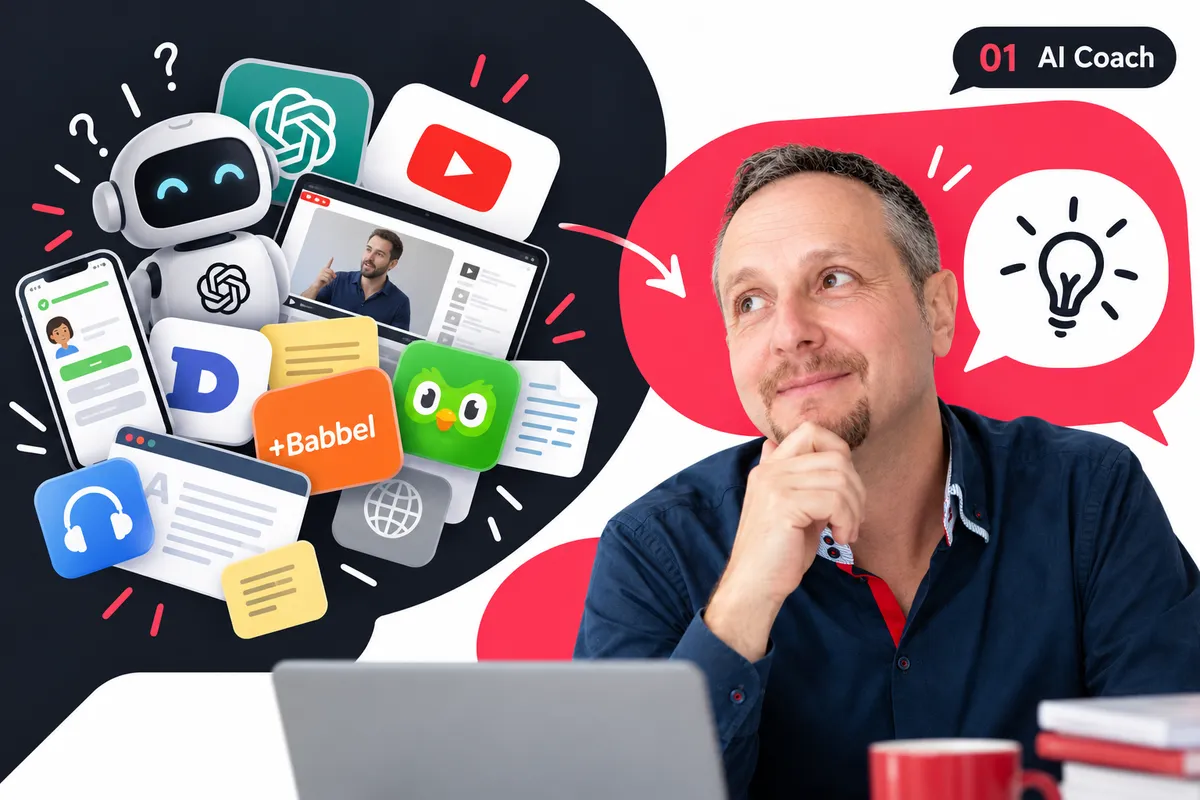
Do You Still Need an English Coach When You Have AI, YouTube and Language Apps?
Do You Still Need an English Coach When You Have AI, YouTube and Language Apps?
You can learn an extraordinary amount of English without paying anyone. YouTube can explain grammar. AI can rewrite an email in seconds. Language apps can keep vocabulary practice in your pocket. So why would an experienced IT professional ever work with an English coach?
Because access to information and progress toward a specific professional goal are not the same thing.
If your target is vague — “I want better English” — free resources may be all you need. If your target is concrete — “I need to lead client meetings without freezing,” “I want to interview for an international role,” or “I need to present a technical recommendation to executives” — the challenge becomes much more specific.
Quick answer: Free tools are excellent for input and practice. Coaching becomes valuable when you need diagnosis, prioritisation, realistic practice, feedback and accountability around a specific professional outcome.
Free resources solve the information problem — not always the performance problem
The internet is full of explanations. What it cannot automatically tell you is which problem deserves your attention first. A developer may think vocabulary is the issue when the real problem is over-explaining. A project manager may keep studying grammar when the real difficulty is answering questions under pressure.
The difference matters. More information is useful only when it is connected to the behaviour you need at work. A targeted plan takes a real situation — a weekly steering call, an interview, a presentation — and works backwards from the result you need.
Professional English is contextual
Generic English practice can improve your overall level, but work communication has its own demands. You may need to explain an incident without sounding defensive, challenge a stakeholder diplomatically, summarise a technical trade-off for a non-technical audience, or recover when you lose a word.
Those are not random language exercises. They are professional scenarios. The vocabulary, tone, structure and delivery all depend on your role and audience.
Want to work on this in your own professional context?
If this is a situation you recognise and you want practical support with your professional English, you can book a short meeting with me. We can look at the situations where communication feels heavier and identify a focused way forward.
What a coach can add that an app cannot easily personalise
A useful coaching relationship should help you identify recurring patterns: where you hesitate, which phrases you overuse, whether your message has a clear structure, how your pronunciation affects clarity, and what happens when the pressure rises.
It should also give you feedback on decisions that are difficult to evaluate alone. Did your answer sound too apologetic? Was your presentation technically accurate but too detailed? Did you answer the question or circle around it? These are performance questions, not only language questions.
Use AI as part of the system, not as a replacement for practice
AI can be extremely useful. You can ask it to generate interview questions, simplify a technical explanation, create vocabulary drills or challenge your argument. But if the goal is speaking, you still have to speak. If the goal is handling pressure, you still need exposure to pressure.
The strongest approach is often a combination: use technology for repetition and preparation, then use human interaction for feedback, nuance and realistic performance.
A practical way to start this week
- Choose one professional situation you want to improve, not “English” in general.
- Use AI or free resources to prepare vocabulary and possible questions for that situation.
- Record yourself responding out loud and listen back for clarity, structure and hesitation.
- Ask a colleague, mentor or coach for specific feedback rather than a generic “How was my English?”
Frequently asked questions
Can AI replace an English coach?
AI can replace or improve many study activities, but coaching can still add value when you need personalised diagnosis, live feedback, accountability and realistic professional simulations.
When is an English coach worth it?
It is most useful when you have a specific goal with real consequences: a new role, important presentation, international meetings, interviews or leadership communication.
Should I stop using language apps if I work with a coach?
No. Apps, AI, videos and coaching can complement each other. The key is assigning each tool a clear job instead of consuming resources randomly.
Final thought
You probably do not need a coach simply because English exists. You may need one when English stands between you and something specific that matters.
The question is not “Which resource is best?” It is “What am I trying to do, what is stopping me, and which combination of tools will get me there fastest?”
Need support with your professional English?
If you want to turn the ideas in this article into something you can use in meetings, presentations, interviews or international conversations, book a short meeting with me. We can see whether targeted coaching is the right fit for you.
